Frequently Asked Questions
Below are the questions we’re asked most often by hunters, first-time safari guests, and non-hunting travellers planning a visit to Tolile Lodge. If you can’t find what you’re looking for, contact us directly — Collin and Louise van Vliet respond to every enquiry personally.
About Tolile Lodge
Where is Tolile Lodge located?
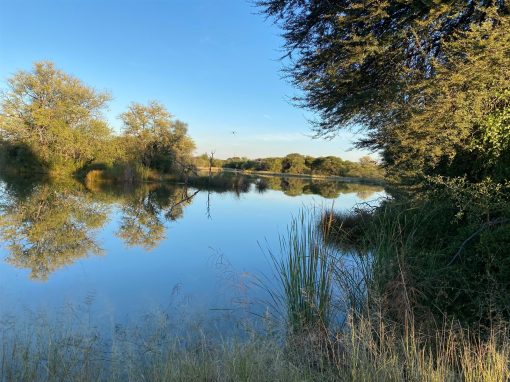
Tolile Lodge sits on the banks of the Limpopo River near Rooibokkraal, Thabazimbi, in Limpopo Province, South Africa — directly bordering Botswana across the river (24°08’47.2″S 26°52’27.1″E).
Who owns and runs Tolile Lodge?
Tolile Lodge sits on more than 11,000 acres of private land, owned by Pieter Prinsloo, who inherited it from his father before him. The family has bred game and hunted this reserve for three generations. The lodge itself — where guests stay, on the river — joined the family nearly a decade ago, and has been guided by professional hunters with intimate knowledge of the property ever since.
What makes Tolile Lodge different from other lodges in the area?
Three things, mainly. First, our 11,000+ acre property carries 40+ species — including 7 rare colour variants, rarely all found together on one property in South Africa — on its own, so most hunts start right at the lodge door rather than after a drive to another camp. Second, we’re on the Limpopo River, so crocodile, hippo, fish eagle, and abundant birdlife are part of daily life here, not a special excursion. Third, and maybe most importantly if this is your first hunt in South Africa: we’re a private, family-owned operation — the same family has been part of this land for three generations. We’re not going anywhere.
What accommodation is available at Tolile Lodge?
Four individually designed river-view suites in the main lodge (the Zebra, Rhino, Fish Eagle, and Leopard Rooms), each with en-suite bathrooms, plus four recently renovated Garden Chalets in the manicured grounds — eight units in total, suited to both couples and larger safari parties.
How do I get to Tolile Lodge?
Guests are met at the Johannesburg Internation airport by our Professional Hunters. We can also arrange for guests to fly-in directly to the lodges private airstrip, for a fee, if requested.
How do I book a safari or make an enquiry?
Contact Collin van Vliet (professional hunter) directly by phone or WhatsApp at +27 72 085 3069, or Louise van Vliet at info@tolilelodge.com / +27 83 755 1097. North American guests can also reach our representatives Andy and Grace Long, and Australian guests can contact Tony Mendes.
Do you have references or testimonials from previous guests?
Yes — you can read guest experiences on our Testimonials page, and we’re happy to share further references directly on request.
Planning Your Trip
When is hunting season at Tolile Lodge?
Hunting season runs April through November, aligned with the dry season when thinned-out bush and cooler temperatures make tracking and stalking far more effective. Non-hunting safaris — game drives, birding, photography — are available year-round.
Do I need a visa to visit South Africa?
Many nationalities, including US citizens, don’t require a visa for short tourist or hunting stays, but requirements can change, so it’s worth confirming directly with South African immigration or with us before booking flights.
Do I need a separate hunting license as a foreign visitor?
No — foreign hunters don’t need their own South African hunting licence. All hunting is conducted under our registered professional hunter, and we arrange the required provincial hunting permits for each animal on your list.
Can I bring my own rifle, or is rifle hire available?
You can bring your own rifle with a South African temporary firearm import permit (arranged in advance through SAPS, using the SAPS 520 form), or hire a rifle at the lodge for a daily fee if you’d rather avoid international firearm logistics. Our team will guide you through this simple process.
How much ammunition can I bring into South Africa?
South African regulations allow up to 200 rounds per firearm of the same caliber. Note that most airlines cap checked ammunition at around 10-11 lbs, so check with your airline before you fly — ammunition must travel in checked luggage or a hard-sided rifle case, never carry-on.
Do children under 18 need special documents to enter South Africa?
Yes. South African law requires any traveller under 18 to carry an unabridged birth certificate showing both parents’ details — without it, entry can be refused. If travelling with only one parent, additional consent documentation may also be required. Please confirm current requirements with South African immigration well before travel.
What are the passport requirements for entering South Africa?
Your passport must be valid for at least six months beyond your departure date from South Africa and should have at least two completely blank visa pages.
What vaccinations or health precautions are recommended?
Fortunately, Tolile Lodge is a malaria free area but we suggest you speak to a travel medicine clinic ahead of your trip — routine vaccinations should be current, and depending on your itinerary, your doctor may discuss hepatitis A, typhoid, and malaria precautions. We’re happy to advise on the specific risk profile for our area and season; South Africa does not require yellow fever vaccination unless you are arriving from a country where it’s endemic.
How fit do I need to be for a hunting safari?
General fitness for several hours of walking on uneven bushveld terrain over consecutive days is sufficient for most plains game hunting. Dangerous game hunts, such as Cape buffalo, are more physically demanding and involve longer tracking on foot.
What should I pack?
Neutral-colored, breathable layered clothing, broken-in boots, sun protection, and binoculars. We provide daily laundry service, so three to four sets of safari clothing is plenty — you can pack lighter than you might expect for a week-plus stay.
Costs and What’s Included
What does the daily rate include?
Professional hunter, tracker, skinner and full camp staff; a dedicated hunting or game drive vehicle; airport transfers; all accommodation; all meals and beverages including alcohol; daily laundry; trophy preparation (skinning, salting, drying, and transport to dip-and-ship); and South African VAT (15%).
What’s charged separately from the daily rate?
International and domestic travel to the lodge, firearm import permits and fees, trophy fees per species taken, gratuities, dip-and-ship and taxidermy costs, rifle hire ($40/day if required), ammunition (approx. $7/round), and accommodation before or after your safari. Wounded-and-lost animals are charged at full trophy price.
How much does a hunting safari at Tolile Lodge typically cost?
Total cost depends on your species list, number of days, and 1×1 vs 2×1 arrangement — see our Pricing page for a general guide. A final, tailored quote is provided on direct enquiry once we know your dates and species of interest.
When do I pay, and what payment methods do you accept?
A deposit secures your booking, with the balance typically settled at the end of your safari. We can advise on accepted payment methods (cash, card, or wire transfer) and any card processing fees when you book.
Is tipping expected?
Yes — gratuities for your professional hunter, tracker, skinner, and camp staff are customary and separate from the daily rate. A common guideline across South African safaris is around 10% of the safari cost, split among staff — we’re happy to advise further.
What’s the difference between a 1×1 and 2×1 hunt?
1×1 means one hunter with one dedicated professional hunter; 2×1 means two hunters share a single PH and vehicle, typically at a lower per-person rate, alternating shot opportunities.
Roughly how much is airfare to South Africa?
From the United States, round-trip economy fares to O.R. Tambo (Johannesburg) typically range from $1,000-$2,400 depending on season and routing, with direct flights available from Atlanta and Newark. Fares are generally lower outside the May-August peak.
Species, Trophy Quality & Fair Chase
What species are available to hunt at Tolile?
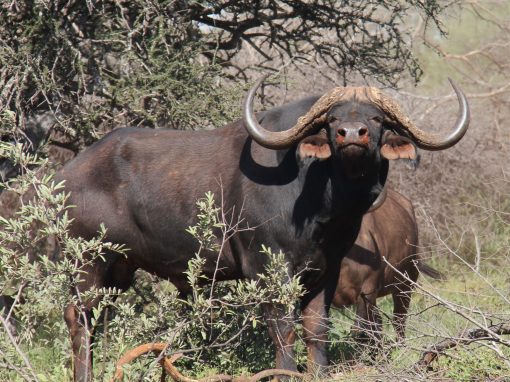
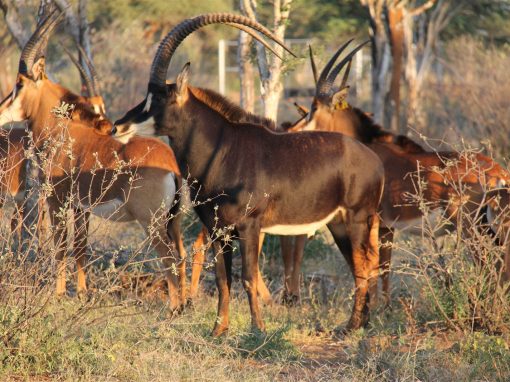
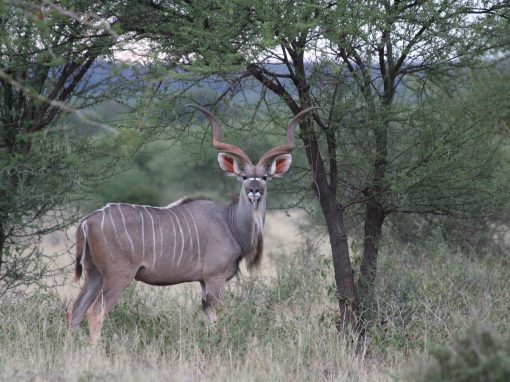
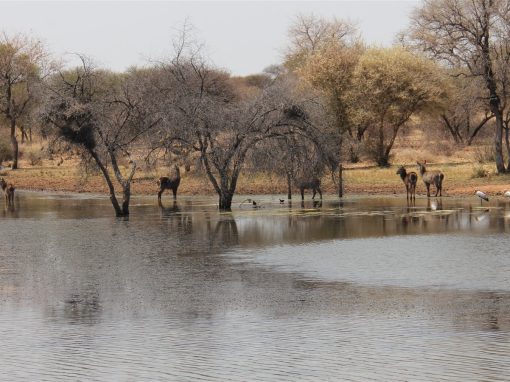
40+ species, including Buffalo (all grades), Sable and Roan Antelope, Kudu, Black Impala, Common Impala, Golden Wildebeest, Golden Oryx, Eland, Zebra, Waterbuck, Warthog, Bushbuck, Nyala, Gemsbuck, Giraffe, Blue Wildebeest, Tsessebe, Red Hartebeest, Blesbuck, Steenbok, Duiker, and more. See the full species list and day rates.
What trophy quality can I expect?
Tolile has earned a reputation for exceptional trophies across three generations of family management, with Roland Ward record-book quality across our signature species — buffalo, sable, and roan.
Is hunting at Tolile Lodge fair chase?
Yes. Our animals are wild, free-ranging populations across extensive bushveld, not confined or habituated stock. Like most private reserves in South Africa, our land has a secure perimeter — this keeps trophy game from wandering onto neighboring farms and keeps predators from decimating herds — but within that boundary, animals live, breed, and are hunted under genuine fair-chase conditions.
How far are typical shots?
Most plains game shots in our thick Limpopo bushveld are taken at 80-200 yards, often through gaps in vegetation, which rewards a steady rest and patience over long-range shooting ability. Your professional hunter will range the animal for you before you take the shot.
What caliber rifle should I bring?
For plains game, a .270 Winchester to .300 Winchester Magnum, or a .30-06 Springfield, are all excellent, popular choices. For dangerous game such as Cape buffalo, a .375 H&H Magnum or larger is required, loaded with premium controlled-expansion and solid bullets.
Can I add or change species once I’m in camp?
In many cases, yes — if you encounter a species you’d like to add to your list, let your professional hunter know and we’ll do our best to accommodate it at the standard trophy fee. Substituting one species for another may be possible depending on your package; ask us when booking.
What happens if I don’t get an opportunity at an animal on my list?
It happens occasionally, especially with once-in-a-trip species. No trophy fee is charged for an animal you don’t get an opportunity at — you only pay for what you take. Talk to your professional hunter about substituting another species or extending your search, depending on time and availability.
What’s your policy on wounded animals?
Our professional hunters are experienced at recognizing a hit, and we’ll spend hours — sometimes days — working to recover a wounded animal. Any animal wounded and not recovered is charged at full trophy price, consistent with standard industry and ethical practice.
Legal & Conservation
Is trophy hunting at Tolile Lodge legal and regulated?
Yes. Every hunt is conducted within annual quotas set by Limpopo Province’s Department of Economic Development, Environment and Tourism (LEDET). Our professional hunters are registered with and licensed by the provincial authority.
How does hunting support conservation?
Hunting revenue gives species like buffalo, kudu, and sable direct economic value on private land, which is what funds anti-poaching efforts, habitat management, and species reintroduction. This model has helped transform millions of hectares of former agricultural land back into managed wildlife habitat across South Africa.
Is this the same as ‘canned hunting’?
No. Canned hunting refers to intensively bred predators hunted in small confined enclosures — a distinct and widely condemned practice. Tolile’s hunts are free-range, fair-chase hunts of naturally occurring populations across extensive bushveld.
What CITES and export permits are required?
Most species hunted at Tolile — including buffalo, kudu, sable, roan, impala, eland, and zebra — are listed under CITES Appendix II or aren’t CITES-listed at all, meaning export permits are routine. Your professional hunter and our appointed dip-and-ship company manage this documentation on your behalf.
Getting your Trophy Home
How long does it take to get my trophy home to the US?
Typically 6-12 weeks from departure to delivery at your taxidermist, covering dip-and-ship processing, CITES export, and USFWS import clearance.
What documentation is needed to import a trophy into the US?
A CITES export permit from South Africa, USFWS Form 3-177 (Declaration for Importation or Exportation), and species-specific import permits where required. Trophies must clear customs through a USFWS-designated port of entry (JFK, LAX, Miami, Chicago, Dallas, and others).
Should I ship raw trophies or have them mounted in South Africa first?
Both options work. Shipping raw (salted skins and skulls) to a taxidermist at home generally costs a little more overall but many hunters prefer the familiarity and after-care of a local taxidermist. Having trophies fully mounted in South Africa before shipping is often marginally cheaper but produces a larger, heavier crate. We can talk through both options based on what you’re taking.
Do I need a customs broker?
We strongly recommend a licensed US customs broker who specializes in wildlife imports specifically, not general commercial freight. Our dip-and-ship partners can recommend proven specialists.
What happens to my trophy on site before it ships?
All trophies are skinned, salted, and dried on site by our experienced skinning team immediately after the hunt, then handed to our dip-and-ship partner for fumigation, crating, and international freight.
Health, Safety & Connectivity
Is it safe to hunt and travel in South Africa?
Yes. As with any destination, some areas warrant more caution than others, but from the moment you’re collected at the airport to the moment you depart, you’re accompanied by our team. The bushveld around Tolile is quiet, remote, and has an excellent safety record with our guests.
Will my cell phone work at the lodge?
Cell coverage at Tolile is limited, as is typical for our remote bushveld location on the Limpopo River. Check with your carrier about international roaming before you travel, and let family or work know to expect intermittent contact during your stay.
Is there WiFi at Tolile Lodge?
Yes — Tolile Lodge offers free WiFi. Cell coverage in the surrounding bushveld is limited, so WiFi is the most reliable way to stay in touch during your stay.
What will the weather be like during my stay?
During hunting season (April-November), expect cool mornings and evenings — sometimes near freezing in June/July — warming to comfortable, dry days. The December-March green season is hot, humid, and prone to dramatic afternoon thunderstorms.
Food & Life In Camp
What’s the food like at Tolile Lodge?
Expect authentic South African cuisine prepared by our resident chef, with three meals a day plus snacks — hearty breakfasts, packed lunches in the field so you don’t have to break your hunting day, and a full evening spread with local wines and drinks. Let us know about any dietary restrictions in advance and we’ll happily cater to them.
Will I get to eat the game I hunt?
Yes — game meat is a regular feature of dining at Tolile, and our kitchen is happy to prepare venison from your own hunt on request. We also cater to individual dietary needs and preferences, so just let us know in advance if you have any restrictions or would prefer non-game options.
Can non-hunting guests join hunters at meals and around camp?
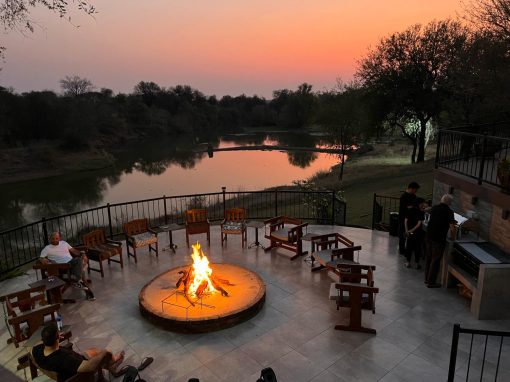
Absolutely — meals, sundowners, and evening fires at Tolile are a shared, social part of the experience for hunting and non-hunting guests alike.
Non Hunting Guests & Family
Can I visit Tolile Lodge if I don’t hunt?
Absolutely — we welcome photographic safari guests, birders, and leisure travellers year-round, with guided game drives, morning bush walks, and the same riverside lodge experience as our hunting guests.
What can non-hunting guests do at the lodge?
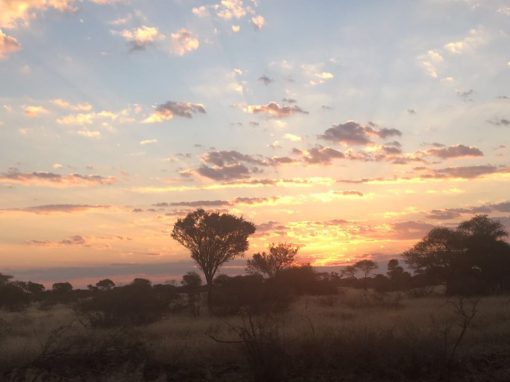
Guided game drives and bush walks to view our 40+ resident species, exceptional birding along the Limpopo River corridor, sundowners on the open plains, bush dining by firelight, and simply relaxing on the river deck watching hippos and Fish Eagles. We also have access to two swimming pools on the property if you’d like to relax around the pool during the warmer months.
Is Tolile Lodge good for a mixed group of hunters and non-hunters?
Yes — this is one of our most common bookings. Hunters head out with their professional hunter each day while the rest of the party joins a game drive or relaxes at the lodge, reconvening every evening for shared meals and sundowners.
Is Tolile Lodge good for birdwatching?
Yes — our position directly on the Limpopo River makes it a premier birding location, with Fish Eagles, kingfishers, egrets, oxpeckers, and (in season) migratory species from Europe and Asia.
View Blog